Drive-In vs Drive-Through Racking
Drive-in vs drive-through racking compared: LIFO vs FIFO access, when to use each, and the back-to-back drive-in configuration for maximum density.
Drive-in and drive-through racking are close cousins — both are high-density systems where forklifts drive into the structure. The difference is how pallets flow in and out, and that single difference decides which one fits your operation.
Drive-in racking loads and retrieves pallets from one side (LIFO); drive-through racking is open at both ends for first-in-first-out flow (FIFO). Choose drive-in for maximum density with uniform stock, drive-through when rotation matters. A back-to-back drive-in layout doubles density in the middle of the floor.
Drive-In vs Drive-Through: The Core Difference
| System | Access | Flow | Best For |
|---|---|---|---|
| Drive-In | One side (single entry) | LIFO — last in, first out | Maximum density against walls; uniform, non-time-critical stock |
| Drive-Through | Both ends (open) | FIFO — first in, first out | Stock rotation; dated products; through-flow operations |
In a drive-in system, each lane has one opening. Forklifts load from front to back and retrieve in reverse order — the last pallet in is the first out. This gives the highest density and works perfectly when the product in each lane is uniform and rotation order does not matter. A drive-through system opens both ends of the lane, so pallets loaded at one side are retrieved at the other — enabling first-in-first-out flow, which is valuable for products with expiry dates or strict rotation needs.
The Back-to-Back Variant
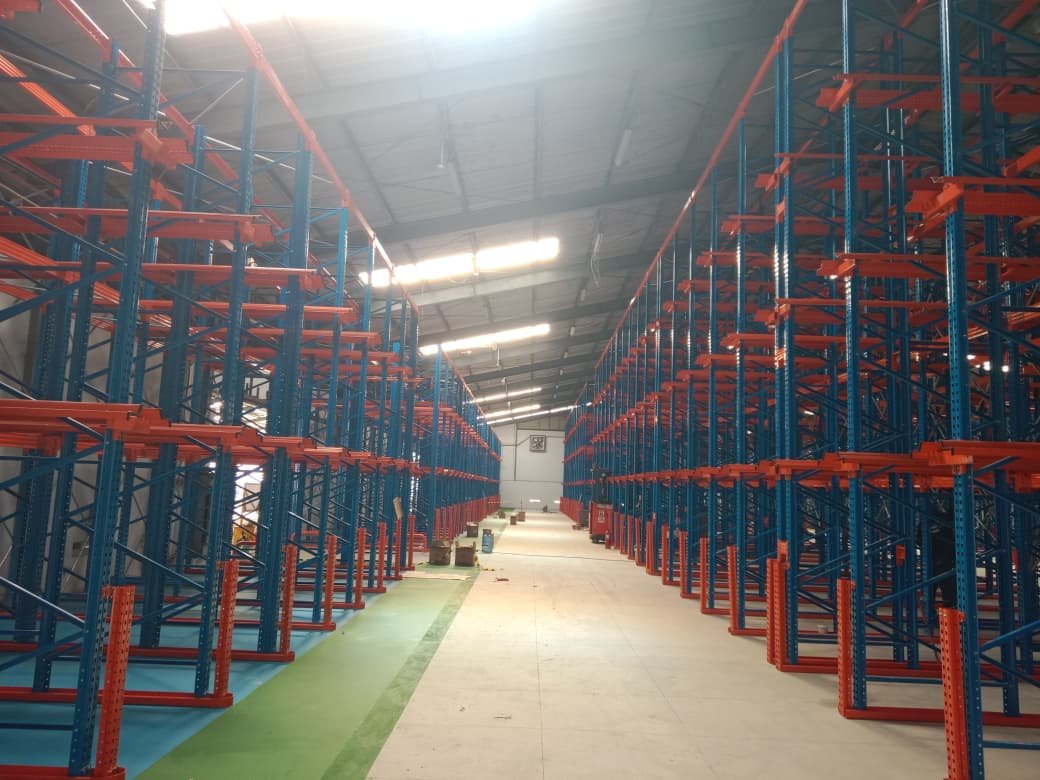
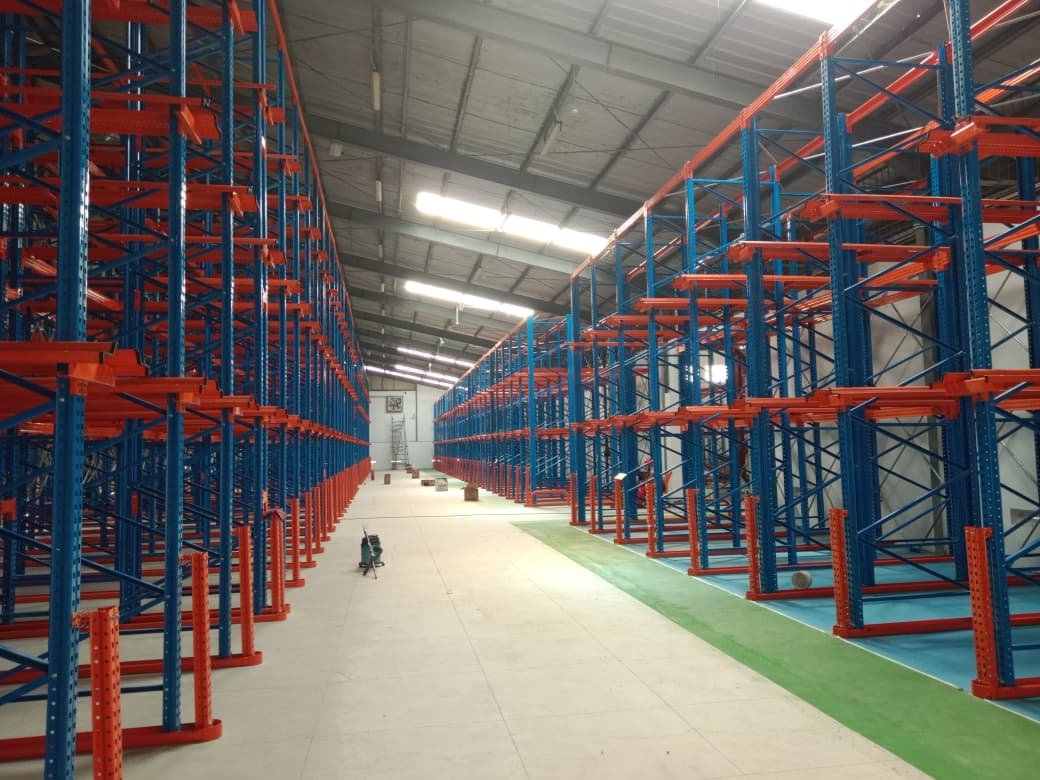
Beyond the standard layouts, the back-to-back drive-in configuration places two drive-in blocks against each other, sharing a central region of the floor. This lets you build high-density storage in the middle of a large warehouse — not only along the walls — scaling total capacity significantly. It is a favourite for big distribution centres where floor area is the main constraint. We engineer back-to-back layouts as part of the design service, balancing density against forklift access.
Specifications We Manufacture
Capacity means nothing without a structure you can trust. These are the technical standards behind every drive-in racking unit from Perkasa Racking (PT. Tangguh Adi Perkasa TAP) — consistent across every project, with no drop in quality wherever your warehouse is.
| Component | Specification & Value to You |
|---|---|
| Upright frame | SHD 120 — the largest profile in its class, manufactured in one piece up to 13,000 mm with no splice. No joint means no weak point. |
| Plate thickness | 2.0 / 2.5 / 3.0 mm, matched to design load — never thinned to cut cost. |
| Support rail | 100 mm footprint, the widest in its class — a broader, more stable bearing surface for pallets. |
| Top tie & back bracing | Fully installed, not a single member omitted — structural safety comes first. |
| Finishing | Powder coating (dry warehouse) or hot-dip galvanizing (cold storage). |
| Material | JIS G3131 & JIS G3101 steel — certified structural grade, not low-grade iron. |
One Manufacturer, Every Configuration
Because we fabricate in-house, we are not limited to a single product. Whether your warehouse calls for classic drive-in density, drive-through FIFO flow, or a back-to-back layout to fill the floor, we engineer and build it to the same standard — SHD 120 frames, JIS steel, full bracing, and ISO-certified production. Tell us how your stock moves, and we design the system that matches it.
See full specifications, types, and order drive-in racking directly on our main site.
Frequently Asked Questions
The questions international buyers ask most before ordering drive-in racking.
What is the difference between drive-in and drive-through racking?
When should I choose drive-in over drive-through?
What is a back-to-back drive-in configuration?
Looking for Drive-In Racking in Indonesia?
High-density, factory-direct, ISO-certified — from our plant in Indonesia to warehouses worldwide. Talk to our team on WhatsApp.
Request a Quote